
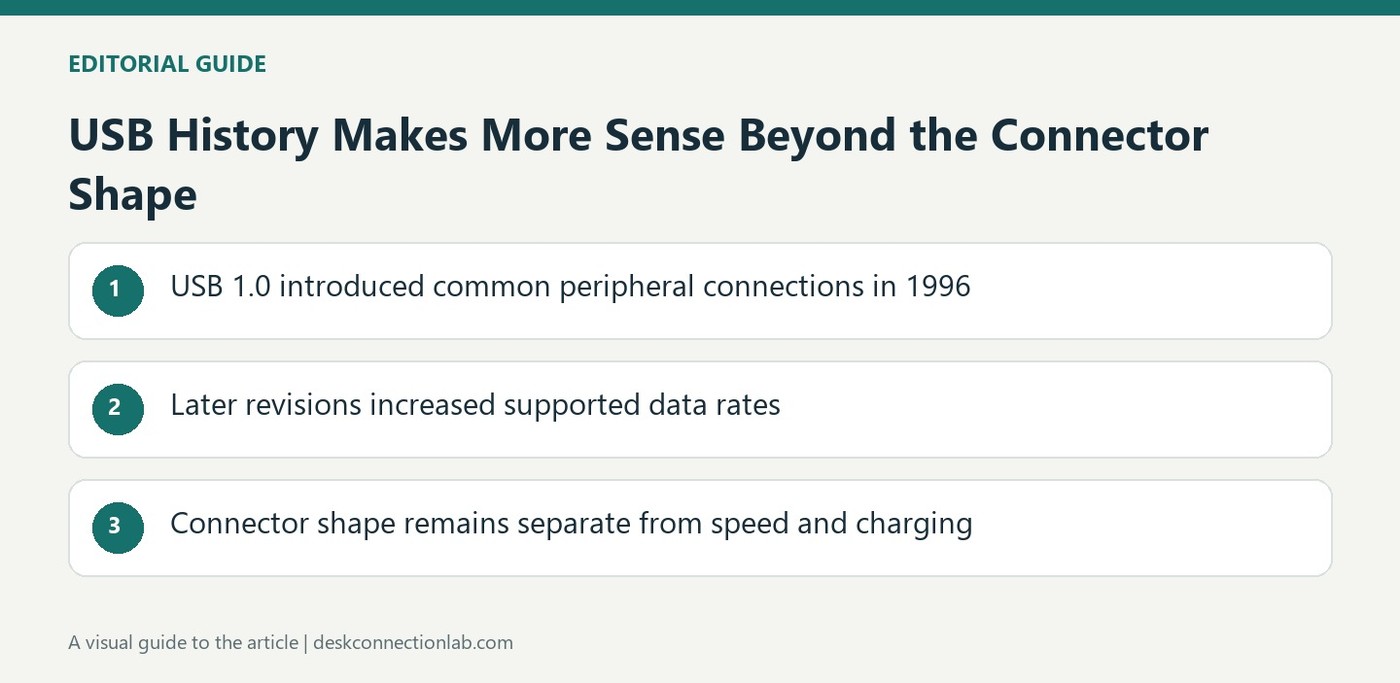
USB History Makes More Sense Beyond the Connector Shape
Why a common connection mattered
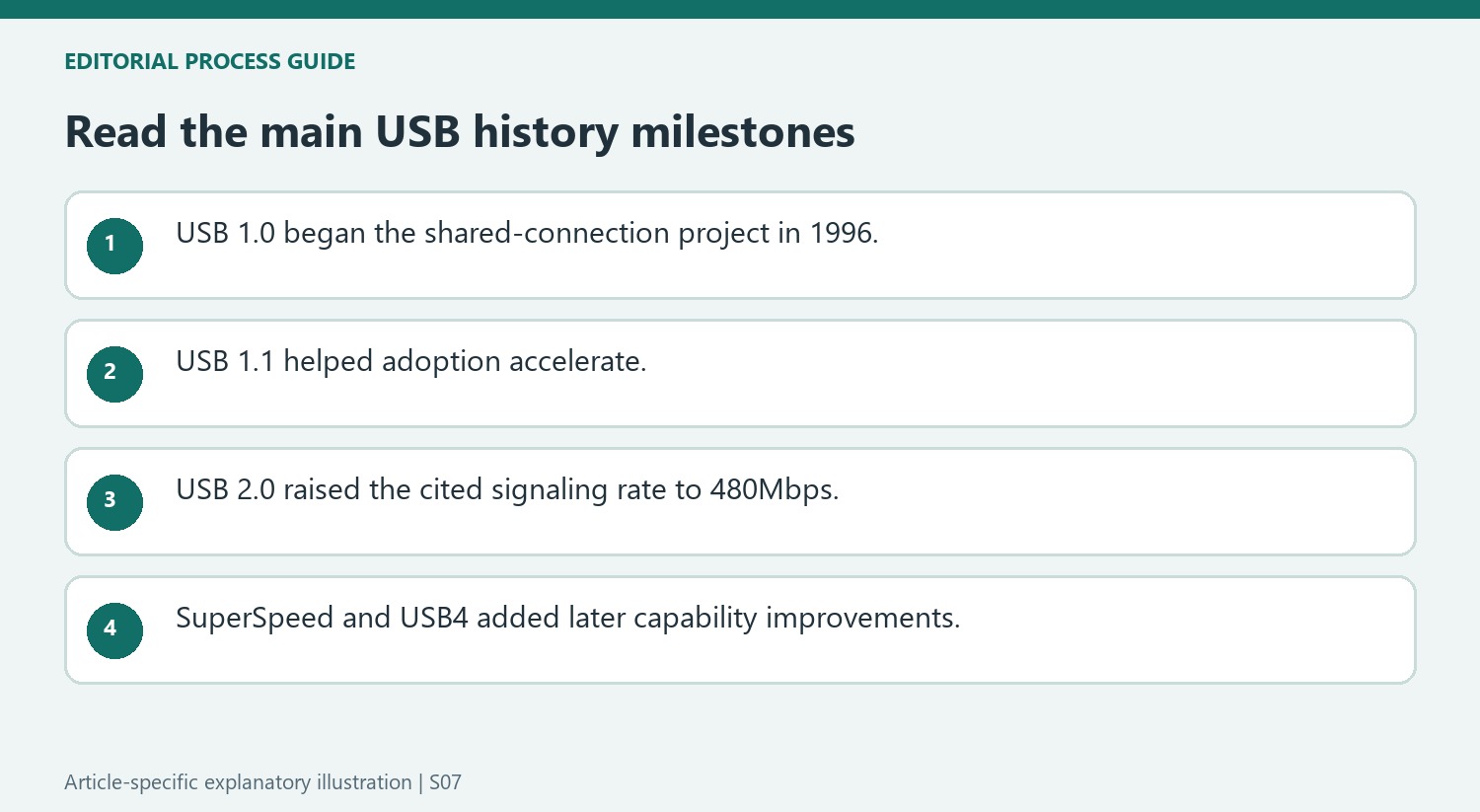
Early personal computers often needed different sockets for different jobs. Serial connections, game ports and other interfaces complicated the task of attaching ordinary accessories. TechRadar's retrospective describes USB as part of the effort to reduce that fragmentation during the 1990s. USB 1.0 arrived in January 1996 with signalling options of 1.5 and 12 Mbps, followed by USB 1.1 in 1998. The attraction was not simply a faster number. A shared connection system made it easier for computer and accessory makers to work toward a common approach to everyday peripheral connections.
Follow the data standard through its revisions
Later revisions expanded the available performance. USB 2.0, introduced in April 2000, raised its headline data rate to 480 Mbps. USB 3.0 subsequently introduced a 5 Gbps SuperSpeed link, while the initial USB4 specification announced in August 2019 supported rates up to 40 Gbps. These are specification milestones, not a promise that every device on a newer computer operates at the highest figure. A transfer still depends on the capabilities of the host, peripheral, cable and intervening hub. Connecting an older device through a newer interface does not upgrade the device's own data controller or storage performance.
Keep socket names separate from capability
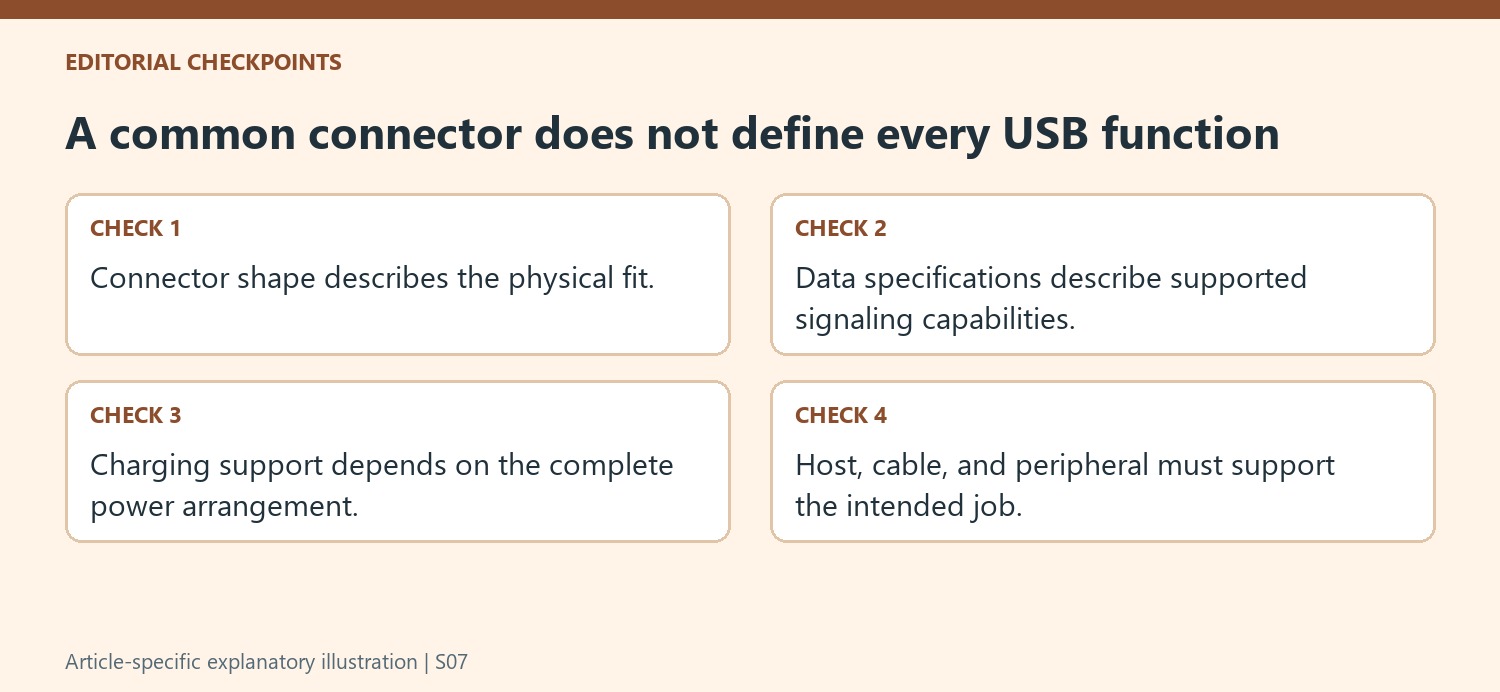
The retrospective becomes more useful when connector terminology is kept distinct from those performance revisions. USB-C describes a connector system; its reversible shape alone does not establish a particular data rate, video feature or charging level. USB-IF documentation explains these capabilities separately, including the role of cable and product implementation. USB-A and other connectors also remain in use, so the historical progression should not be read as an immediate replacement of every older socket. When choosing equipment today, identify the physical connection first, then confirm the documented speed, power and display functions needed for the intended task.
Follow the shift from specialized ports to a shared connection
The early USB project responded to a computer environment filled with different peripheral interfaces. Serial, game, and other dedicated connections made choosing and attaching equipment more complicated. The source places the first USB release in 1996 and describes the collaboration of several major technology companies. This history helps explain the standard's purpose: make common computer connections easier to manage across many products. It does not mean the first release immediately displaced every alternative. The article notes slow early uptake and later momentum with USB 1.1, showing that an agreed standard and widespread practical adoption are separate stages. Hardware availability and support had to develop alongside the specification.
Read the speed milestones as changes in capability
The historical figures in the article show the scale of the change: early USB offered low signaling rates, USB 2.0 brought a 480Mbps figure, and the SuperSpeed generation introduced 5Gbps operation. USB4 later raised the ceiling further, drawing on Thunderbolt 3 technology. These numbers explain why later generations could support more demanding tasks, but they are not predictions of every real file transfer. The complete connection still includes the host, device, cable, and the particular modes they support. When looking at a product today, identify its stated data capability directly. A broad reference to USB can encompass equipment designed for very different levels of performance.
Keep connector shape distinct from supported functions
USB-C made the physical connection more consistent across many modern devices, but that consistency can hide different electrical and data capabilities. A USB-C cable intended primarily for charging is not automatically equivalent to one specified for a fast storage connection. A laptop socket may also support a different collection of functions from another socket with the same outline. The historical story is therefore most useful as two related developments: the evolution of the standard's capabilities and the growth of a common connector. For a practical purchase, ask what job the connection must perform, then check the supported speed, power, and other required functions. A recognizable plug makes connecting simpler only after those requirements match.
References
- USB hit the scene 30 years ago this month - we look back on its journey to standardization success. TechRadar; Ross Kelly.
- USB Type-C® Cable and Connector Specification. usb.org.
- USB4®. usb.org.
USB evolved from a simpler connection standard into faster data links; connector shape, data speed and charging remain separate questions.


Leave a Comment
Comments (0)